 , Leadership & Talent Consultancy, GatenbySanderson delivered an online session exploring strengths-based development, highlighting how understanding and leveraging strengths can create a more inclusive and impactful workplace. This article is part of a series focusing on inclusive leadership and strengths-based development. View more content on these topics below.
Related content:
, Leadership & Talent Consultancy, GatenbySanderson delivered an online session exploring strengths-based development, highlighting how understanding and leveraging strengths can create a more inclusive and impactful workplace. This article is part of a series focusing on inclusive leadership and strengths-based development. View more content on these topics below.
Related content:
- Driving Impact through strengths-based development - webinar recording
- Focus-shift: develop your strengths rather than weaknesses to increase energy and value
- Leveraging Strengths for Inclusion: The Key to Unlocking Engagement and Productivity
- Cultural intelligence and inclusive leadership webinar – key takeaways
Develop your strengths rather than weaknesses: Increase energy and value
Most of us are predisposed from a young age to focus on improving what we’re not good at. For example, when you were a child, you may have received a school report with some good grades and some poor grades. Which grades did you focus on when you saw the report? Which did your parents focus on? Research tells us that 70% of parents focus on the poor grade. When you think about the performance of others what do you think about?- What they’re good at?
- Or where they’re not delivering what you want?
- 6 x more likely to feel engaged in their jobs
- Achieve 36% higher performance
- Are up to 43% more productive
- 83% more likely to be part of a high performing team
- 3 times more likely to report having a high quality of life
- Step 1: Think about the day-to-day tasks you have to perform and write them down using the model on page 5 - 6 to plot them.
- Step 2: For each task consider where this falls for you in relation to the model below:
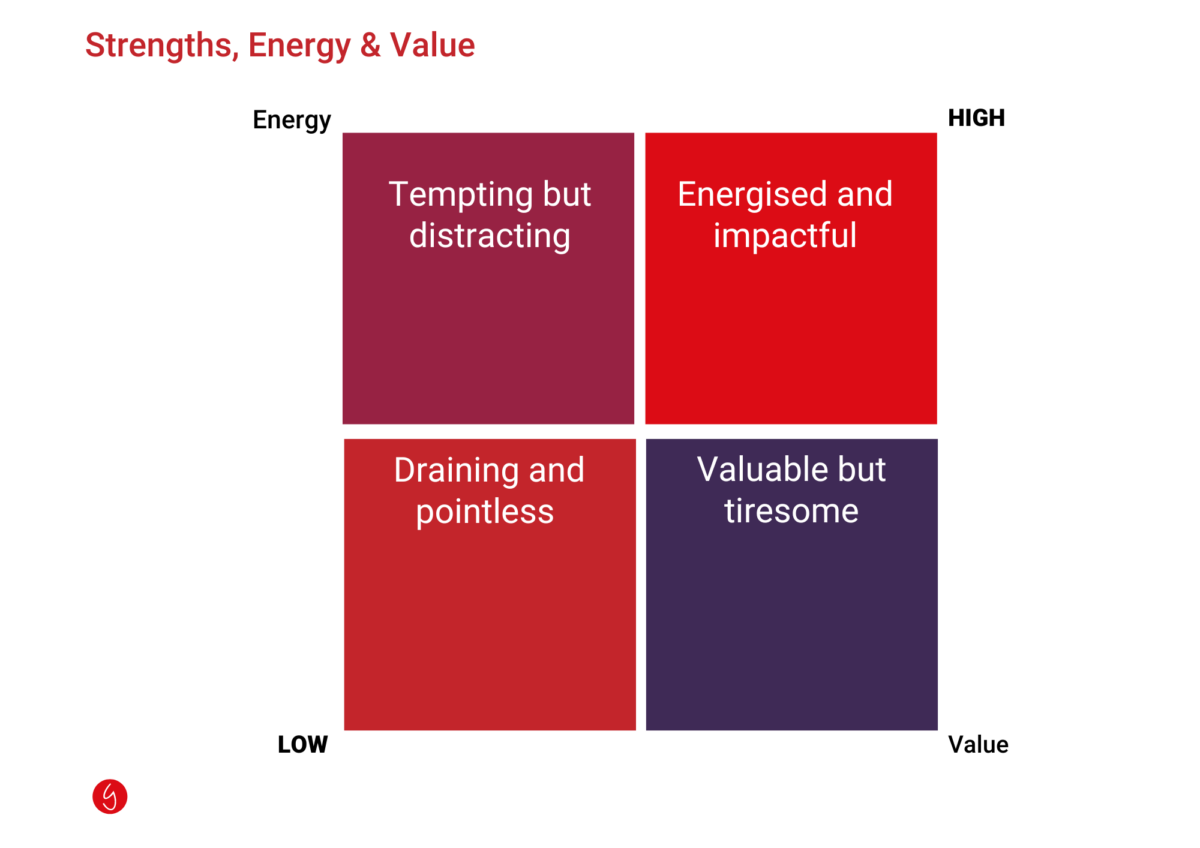 Valuable but tiresome: These tasks add value to your organisation but leave you feeling tired or uninspired. You know it’s important, but it feels like a drag to get through it doesn’t excite or energise you, so it feels tiring to do.
Whilst you might assume that strengths are the things you are good at doing, it’s not necessarily the case. You might have learnt to be good at something, yet it can take you quite a long time to muster up the energy and enthusiasm to do it.
Draining and pointless: These tasks are both emotionally and physically draining, and they offer little or no value to the organisation. They feel like a waste of time and energy, often leading to feelings of frustration or resentment that you even have to do them. For a lot of people, we often find that certain meetings can fall into the box, particular routine ones where they don’t know the purpose and they don’t make any contribution.
Tempting but distracting: These tasks are fun, engaging, and energising, but they don’t contribute much to organisational goals. It’s easy to get pulled into them even though they aren’t the most important things on your plate. It’s important to recognise that we are motivated to chase the energy of our strengths because they make us feel good but it’s where we can overuse our strengths and they can get in our way, which is where strengths may turn into weaknesses as we overdo them.
Energised and impactful: These tasks are absorbing, energising and your impactful. You’re performing at your best and adding significant value to the organisation. Time flies, and you feel fulfilled and excited about the work.
Consider what you could do about the activities that are valuable but tiresome and draining and pointless.
Questions to ask yourself:
Valuable but tiresome: These tasks add value to your organisation but leave you feeling tired or uninspired. You know it’s important, but it feels like a drag to get through it doesn’t excite or energise you, so it feels tiring to do.
Whilst you might assume that strengths are the things you are good at doing, it’s not necessarily the case. You might have learnt to be good at something, yet it can take you quite a long time to muster up the energy and enthusiasm to do it.
Draining and pointless: These tasks are both emotionally and physically draining, and they offer little or no value to the organisation. They feel like a waste of time and energy, often leading to feelings of frustration or resentment that you even have to do them. For a lot of people, we often find that certain meetings can fall into the box, particular routine ones where they don’t know the purpose and they don’t make any contribution.
Tempting but distracting: These tasks are fun, engaging, and energising, but they don’t contribute much to organisational goals. It’s easy to get pulled into them even though they aren’t the most important things on your plate. It’s important to recognise that we are motivated to chase the energy of our strengths because they make us feel good but it’s where we can overuse our strengths and they can get in our way, which is where strengths may turn into weaknesses as we overdo them.
Energised and impactful: These tasks are absorbing, energising and your impactful. You’re performing at your best and adding significant value to the organisation. Time flies, and you feel fulfilled and excited about the work.
Consider what you could do about the activities that are valuable but tiresome and draining and pointless.
Questions to ask yourself:
- How important are they?
- How important is it for you to do these, or could someone else in the team do them? (Just because it drains you, it might be really energising for someone else who will then do it quicker, faster, and easier than you)
- What complementary partnerships might you be able to develop with others to help you?
- What could you stop doing?
- If you must absolutely do the things that drain you because they are fundamental to your role, how might you sandwich them in-between your more energising activities?
- What could you do about the activities that you love doing but aren’t adding value to your role?
- How might you be able to ‘time box’ the amount of time you spend here so it doesn’t become a distraction for you?
- What could you do to satisfy the needs of these strengths and their needs outside of you day to day work?
- What could you do to be able to spend more time on the tasks where you feel productive, energised, engaged and are adding value?
- What might you be able to experiment with right now to learn and see what’s possible and what emerges so you can spend more time playing to your strengths and feeling energised?
- What do you need in terms of support, resources, and consent to make it safe for you to try?
- Step 1: Recreate the model onto a wall, large table or floor depending on the space you have available.
- Step 2: Explain the model to the team and the purpose behind exploring it. Alternatively, you can ask each person to complete the exercise in advance of coming together as a team to explore it.
- Step 3: Ask each person to put their activities onto post it notes (1 per post it) and then place each one into the area of the grid it sits for them.
- Step 4: Invite the team to look at the grid and share their observations.
- What activities do we find most energising?
- What activities do we find most draining?
- What can we do about the activities that are draining for us but add value to the organisation? Are there any opportunities for ‘swaps’ in the team (i.e. someone finds an activity draining that someone else finds energising). Can someone else do it?
- What activities are draining and not adding value to the organisation? What can we do about them?
GatenbySanderson is the UK’s leading people advisory firm delivering executive search, including interim, and leadership & talent consultancy across public services, not for profit and education. For more information, or to ask a question, please contact Vicki Haverson – vicki.haverson@devgatenbysanderson.com